Medien als Lehrperson einsetzen
Richard Conrardy
19.10.2026
Modelle
Constructive Alignment
- Teachers need to be clear about what they want their students to learn, and how they would manifest that learning in terms of “performances of understanding”. For example, memorising and paraphrasing are not performances of understanding; recognising an application in a novel context is.
- The performance objectives thus emerging need to be arranged in a hierarchy from most acceptable to barely satisfactory; this hierarchy becomes the grading system.
- Students need to be placed in situations that are judged likely to elicit the required learnings.
- Students are then required to provide evidence, either by self-set or teacher-set tasks, as appropriate, that their learning can match the stated objectives. Their grade becomes the highest level they can match convincingly.
Construktive Alignment nach Biggs (1996) wird öfters zusammengefasst als ein gleichseitiges Dreieck mit den drei Knoten: Lernziel, Beurteilungsanlass und Lerninhalt.
Lesen Sie Biggs quer.
Ist diese graphische Darstellung adäquat und korrekt?
Wie gehen Sie bei der Planung mit diesen drei Komponenten um?
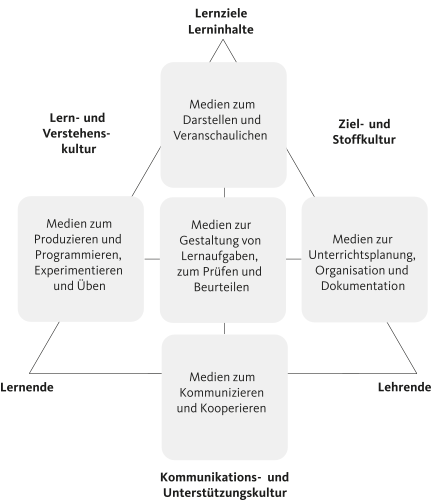
Abbildung 1: Mediendidaktisches Dreieck (Petko, 2020, S. 120).
| Schritt | Bedeutung |
|---|---|
| PA | Problemorientiertes Aufbauen: Ein relevantes Problem wird bemerkt oder präsentiert. Das Problem muss nicht unbedingt von den Schülerinnen und Schülern alleine gelöst werden, sondern kann auch im fragend-entwickelnden Unterricht bearbeitet werden. |
| D | Durcharbeiten: Das Problem wird in seinen wesentlichen Bestandteilen durchdacht und ihr Zusammenhang wird im Hinblick auf die Lösung verstanden. Dabei werden Begriffe und Operationen aufgebaut und kognitive Beweglichkeit gefördert. |
| U | Üben: Durch Wiederholung soll das Gelernte gefestigt und automatisiert werden. Neben repetitiven können auch zunehmend anspruchsvolle Übungsformen das Lernen unterstützen. Durch erfolgreiches Üben steigt zudem die Motivation und das Vertrauen in die eigenen Fähigkeiten. |
| A | Anwenden: Lernende sollen zunächst unter Anleitung und dann auch alleine in der Lage sein, einen Transfer des Gelernten auf verwandte Wissensgebiete zu leisten. Lehrende müssen hierzu geeignete Transferaufgaben entwickeln. |
ICAP
| PASSIVE Receiving |
ACTIVE Manipulating |
CONSTRUCTIVE Generating |
INTERACTIVE Dialoguing |
|
|---|---|---|---|---|
| LISTENING to a lecture |
Listening without doing anything else but oriented toward instruction | Repeating or rehearsing; Copying solution steps; Taking verbatim notes | Reflecting out-loud; Drawing concept maps; Asking questions | Defending and arguing a position in dyads or small group |
| READING a text |
Reading entire text passages silently/aloud without doing anything else | Underlining or highlighting; Summarizing by copy-and-delete | Self-explaining; Integrating across texts; Taking notes in one’s own words | Asking and answering comprehension questions with a partner |
| OBSERVING a video |
Watching the video without doing anything else | Manipulating the tape by pausing, playing, fast-forward, rewind | Explaining concepts in the video; Comparing and contrasting to prior knowledge or other materials | Debating with a peer about the justifications; Discussing similarities & differences |
Partnergespräch zu ICAP (Chi & Wylie, 2014):
Leitfragen:
- Sind die Kategorien klar definiert?
- Sind die Kategorien erschöpfend und disjunkt?
- Entspricht die Ordnung ihrer Erfahrung?
- Welche Tools unterstützen bei welcher Kategorie?
| Educational technology use | ICAP-TS (theta) |
Passive | Active | Constructive | Interactive |
|---|---|---|---|---|---|
| Presentation software | .398 | .559 | .387 | .314 | .267 |
| Specific-subject learning software | .407 | .353 | .384 | .377 | .350 |
| Online test and quizzes | .406 | .365 | .378 | .367 | .360 |
| Word-processing software | .450 | .379 | .441 | .432 | .418 |
| Spreadsheet and calculation software | .392 | .303 | .359 | .322 | .311 |
| Games | .343 | .268 | .312 | .308 | .305 |
| Learning management system | .470 | .440 | .536 | .412 | .377 |
| Drawing and image editing software | .365 | .259 | .306 | .340 | .309 |
| Video recording and editing software | .318 | .172 | .219 | .334 | .317 |
| Online research software | .500 | .391 | .448 | .519 | .470 |
| Online communication software | .453 | .344 | .397 | .409 | .431 |
| Students’ work presentation/publication software | .516 | .345 | .410 | .506 | .518 |
Note. All correlations are significant at p < .001. Bold values mark the highest correlation coefficient among the four subscales.
Gruppenarbeit

Show and tell
Meine Vorschläge


Gruppenarbeit
Rechtliches

Urheberrecht
- Bilder wie das links: CC BY Soco St via SVG Repo
- Eigene Slides unter CC BY-SA 4.0
Literatur
Antonietti, C., Schmitz, M.-L., Consoli, T., Cattaneo, A., Gonon, P., & Petko, D. (2023). «Development and Validation of the ICAP Technology Scale to Measure How Teachers Integrate Technology into Learning Activities». Computers & Education, 192, 104648. https://doi.org/10.1016/j.compedu.2022.104648
Biggs, J. (1996). Enhancing Teaching through Constructive Alignment. Higher Education, 32(3), 347–364. https://doi.org/10.1007/BF00138871
Chi, M. T. H., & Wylie, R. (2014). The ICAP Framework: Linking Cognitive Engagement to Active Learning Outcomes. Educational Psychologist, 49(4), 219–243. https://doi.org/10.1080/00461520.2014.965823
Petko, D. (2020). Einführung in die Mediendidaktik: Lehren und Lernen mit digitalen Medien (2. Auflage). Beltz.